
Laurie Reinhardt
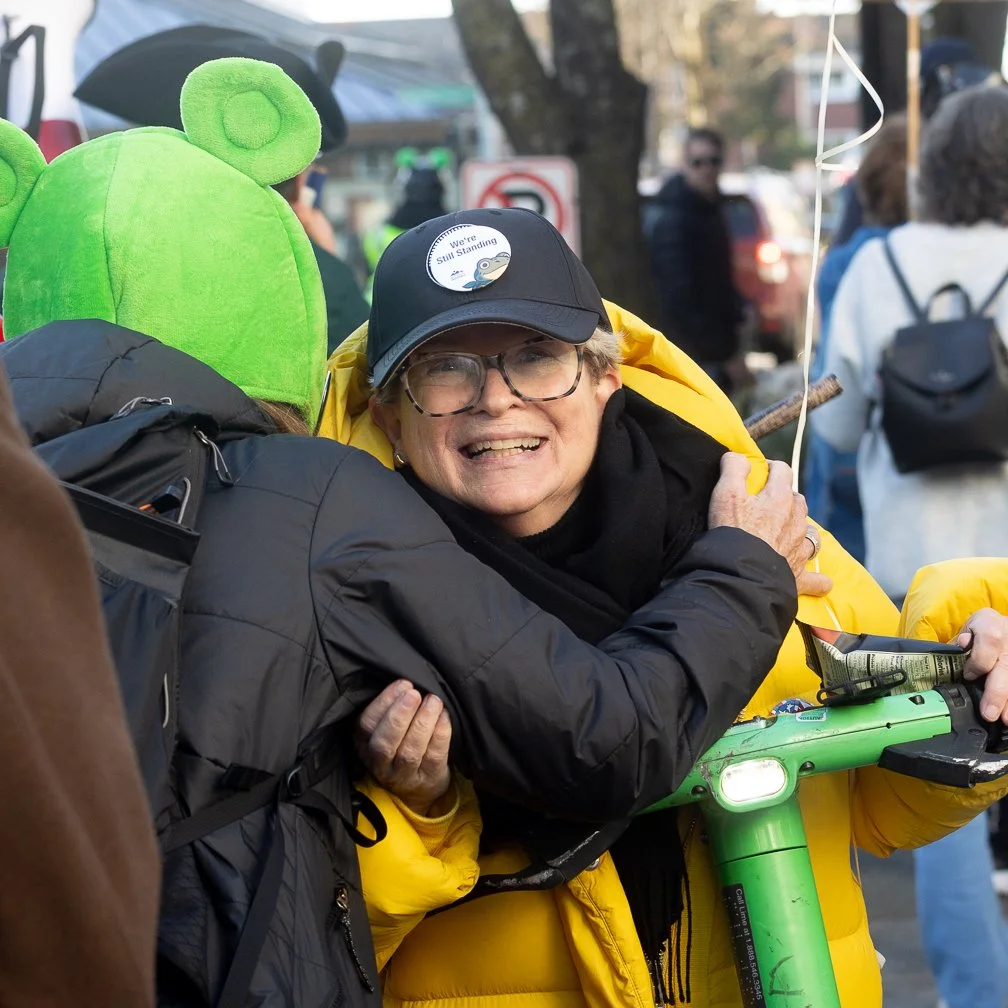
WSI Co-leader Laurie Reinhardt traveled to Minneapolis to observe how they resisted the surge of Federal agents. Her main question: What do you wish you had known or done three months ago?
NEIGHBORHOOD-ISM DEFEATS FEDERAL INVASION
By Chris Mrak
A catch in her throat, a mist in her eye, evinced the profound experience of WSI Co-Director Laurie Reinhardt’s recent visit to Minneapolis as she described the inspiration of seeing a community defend itself from the ground up.
Organized by Common Power (a Seattle voting advocacy organization), a delegation of representatives of Common Power, WSI, Seattle Indivisible, the Mayor’s office and South Seattle Emerald News visited Minneapolis during the period Feb. 1-5. The shared goal was to “learn from the bottom up” how Minneapolis had organized itself to respond to an invasion of thousands of Federal immigration agents.
Seattle delegates spread out, starting with known contacts to see “what would evolve”. Laurie began with a dear friend and neighborhood Indivisible chapters.
Minneapolis is mobilized in faith communities, small businesses, Indigenous groups and everyday neighborhood people. Active participation is evident in a substantial percentage of the population. ICE OUT signs are ubiquitous. Restaurants are unlocked only to admit true customers. People are invited to participate in whatever of many ways contributes to one of two L“buckets” – ICE WATCH and MUTUAL AID.
Like Russian nesting dolls, the city is mapped into ever smaller grids. Each region is divided into four parts which is further divided into neighborhoods mapped block by block. Neighborhood Patrols operate 24/7. Communication is by word of mouth or secure Signal chat. Participants are vetted by neighbors who vouch for their integrity. If a unit is infiltrated by spies or agent provocateurs, that unit is closed to protect the community.
ICE WATCH is divided into tasks – some track ICE/CBP movements. Some warn residents (eg. whistles). Some follow ICE/CBP vehicles. Most schools have Neighborhood Patrols on every corner. One resident stationed himself near the Whipple Detention Center to photograph ICE/CBP license plates to enter into a database. 23,000 people have trained as “Constitutional Observers", a perhaps more evocative term for “Rapid Response Teams”.
When Laurie inquired about the effectiveness of whistle use, the response was: “If you don’t alert people you give ICE one for free. You alert people by making noise to get an immediate response.”
MUTUAL AID is an effort by the grass-roots community to support its residents who are unable or afraid to leave their homes. This communal organization affected Laurie most profoundly. The range of neighborhood groups that stepped up to collect and deliver groceries, diapers and (no paper trail) cash ranged from churches/synagogues to yoga studios to sex shops.
Laurie delivered groceries for one church whose pastor had voted for Trump but now oversaw a huge grocery collection and distribution center with up to 4000 volunteers delivering a million pounds of groceries. Deliveries threatened by ICE/CBP “tails” abort their deliveries and literally eat the address slips to avoid leading ICE/CBP to vulnerable residents.
Another church organized a “singing resistance” outside of hotels where ICE/CBP agents were staying. Seattle Indivisible delegate Kathleen Carson joined in the singing.
An Indigenous group runs a “way station” for ICE/CBP followers to regroup, debrief and wash the tear gas out of their eyes.
Community organizing and response remains an emerging and growing phenomenon. Even two months into the Federal invasion, Laurie saw new people joining the resistance for the first time.
Laurie asked her Minneapolis counterparts what they wish they had known three months ago. The response– activate the legal community earlier to build capacity for effective legal response.
The Federal invasion has caused financial and emotional damage, leaving the Minneapolis community in need of repair, which will take time and money. Laurie says she saw “in every person from whatever economic strata, trauma and pain from the cruelty and brutality, right under the surface, which did not take long to break through”. As one woman told Laurie: “It’s hard to fathom the degree of violence and cruelty. They do not de-escalate. Whatever you do, don’t get violent.”
On the other hand, another person shared the profound change that people have seen in one another: “Neighborhood-ism – how connected we now are – it’s a privilege to be living in this moment. Everyone is doing something.”
Laurie asked her Minneapolis counterparts how we can support them. The response: “Keep telling our story”.