
Jen Nye
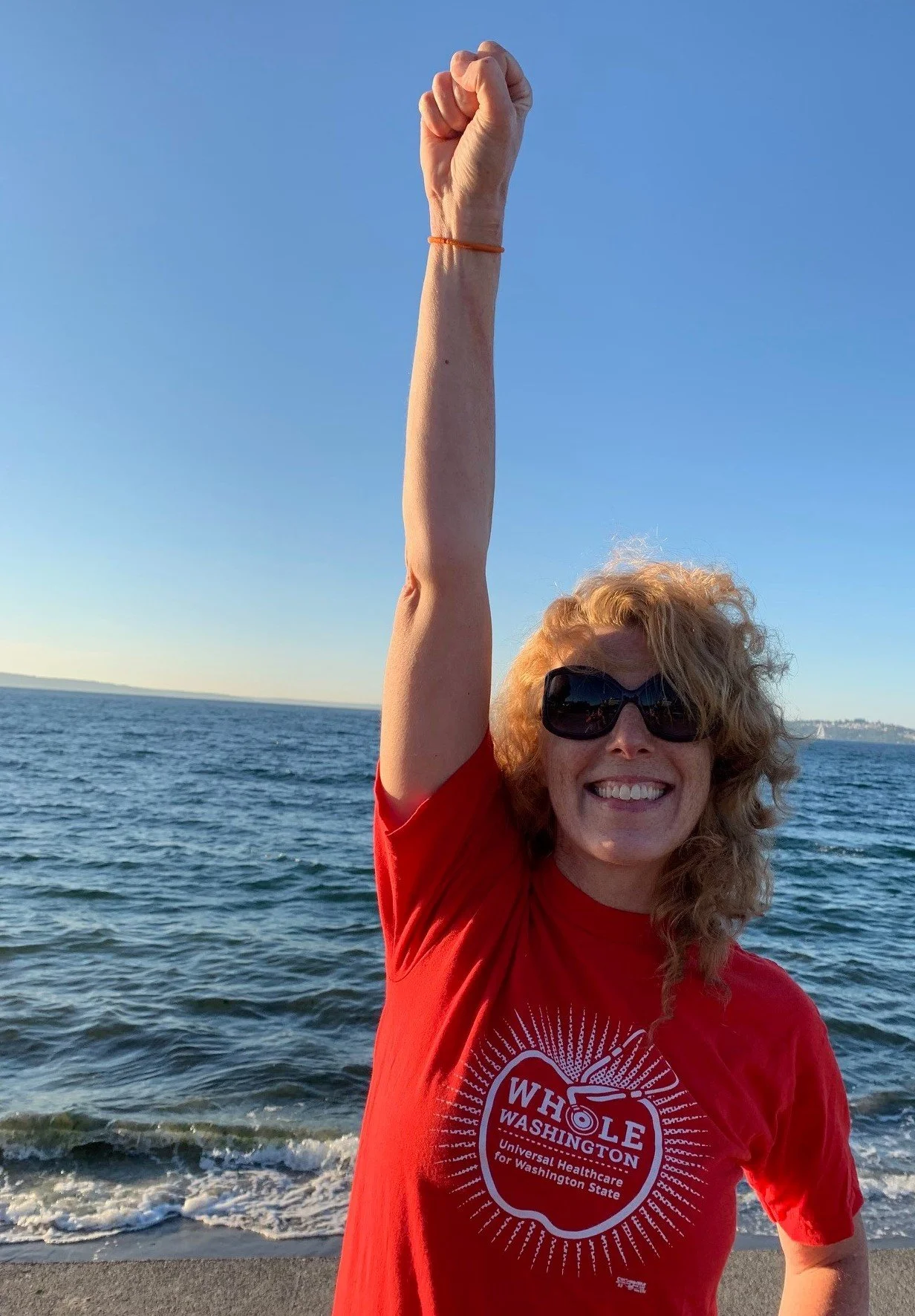
Jen Nye, Director of Volunteer Engagement, has been with Whole Washington since 2017 and is more committed than ever to securing universal healthcare for Washingtonians.
By Jeanne Moore
As healthcare access faces growing uncertainty nationwide, advocates at Whole Washington are advancing a bold solution. The organization is working to introduce new legislation that would create the Washington Health Trust, a program allowing all Washington residents to enroll in comprehensive healthcare at no cost to individuals.
Jen Nye, Director of Volunteer Engagement, has been with Whole Washington since 2017 and is more committed than ever to securing universal healthcare for Washingtonians. Jeanne Moore of WSI recently spoke with Jen Nye about the effort. This interview has been edited for length and clarity.
WSI: Thank you for taking the time to speak with me. To start, could you briefly describe the work being done at Whole Washington—what the goal is, the plan, and how it would benefit people?
Jen: Whole Washington is organizing to win universal healthcare at the state level. Ideally, everyone in the country would have access to universal healthcare, but we believe the national platform is currently stymied. The federal government feels hostile to real transformation, so we see a breakthrough at the state level as much more possible.
Our work focuses on Washington State. We are fighting legislatively, but if elected officials fail to act, we are prepared to launch a signature-gathering campaign to put universal healthcare on the ballot. If we succeed, any Washington resident would be able to enroll in comprehensive healthcare coverage.
That means no networks, no deductibles, no copays, and no cost barriers to care before, during, or after treatment. There would be no surprise medical bills. Coverage would include the whole person—dental, vision, mental health care, gender-affirming care, and whatever your doctor determines you need. It eliminates the third-party middleman: insurance companies. Instead, we would have a functioning public healthcare system.
WSI: It sounds incredible--but I wonder how something so comprehensive could possibly be affordable?
Jen: That’s one of the biggest misconceptions. It’s actually cheaper. The main reason is that we would eliminate an entire industry that extracts enormous wealth from the system while actively blocking access to care. Insurance companies don’t provide healthcare—they provide complexity. They make money by denying care, delaying care, and confusing people until they give up.
If you ask, “What value do insurance companies actually add?” it’s surprisingly hard to answer. They insert themselves between patients and doctors through prior authorizations, narrow networks, and endless administrative hurdles. All of that disappears under a single-payer system. Doctors make medical decisions, not corporate executives with no medical training.
WSI: Interestingly, opposition to insurance companies is one area where people across the political spectrum seem to agree.
Jen: Absolutely. The current system doesn’t make financial sense, and it severely restricts freedom. Your healthcare is tied to your job, your spouse, or staying below a certain income threshold. It traps people in jobs they don’t want. It’s also incredibly cruel. People in other countries don’t experience this constant fear of financial ruin just for getting sick. It doesn’t have to be this way.
WSI: Have other countries influenced your model?
Jen: We do look at other countries, but the U.S., and Washington State specifically, is its own beast. We have to operate within our existing tax structure and available revenue streams. In terms of transformation, our model is most similar to Canada. Canada started with one province—Saskatchewan—adopting universal healthcare, and the rest followed. That’s what we hope for here: that one or two states break through and show it’s possible. Then it becomes unstoppable.
Washington has led the nation before—on marriage equality, cannabis legalization, and other quality-of-life improvements. There’s no reason we can’t lead again, especially on something that would improve everyone’s life more than almost anything else.
WSI: How did you personally get involved with this work?
Jen: I got involved in 2017. I’ve always had left-leaning, socialist values, even growing up in rural Ohio. Bernie Sanders’ campaign was the first time I heard single-payer healthcare clearly explained and championed, and it felt like a no-brainer.
Around that time, my brother became ill while living in Chile and needed extensive testing, including an MRI. When we checked out, the staff was apologetic about charging us—about $50. That experience was eye-opening. In the U.S., seeking care comes with existential stress: Will this bankrupt me? Will I lose my savings? I’m in my 50s, and this is the time where things start breaking down, and it can involve a lot of tests, blood work, scans, or whatever, and it is wild how much all that can cost.
I attended a single-payer healthcare conference in Las Vegas and met the founding members of Whole Washington. Many of them were nurses who had previously worked on a campaign to get money out of politics. They realized that nearly everyone lacked real healthcare security, and that no one was pushing hard enough for change. They decided to act.
That same weekend, there was the mass shooting on the Las Vegas Strip, and many of the nurses stayed behind to help local hospitals. That’s the kind of people who lead this movement—healthcare workers who see the system’s failures every day and still devote their free time to fixing it.
WSI: That’s awesome. I’m wondering, how would this system be paid for?
Jen: Under the current proposal, the majority of funding would come from employers, replacing what they already pay for private insurance. Instead of unpredictable insurance premiums, employers would pay a payroll tax based on business size—ranging from about 4.5% for small businesses to a maximum of 10.5% for the largest.
For most employers, especially small and medium-sized businesses, this would save money and remove the burden of managing health plans. The funds go into a dedicated healthcare trust that covers everyone, not just employees. You wouldn’t need a job or meet income requirements—just residency in Washington.
WSI: How have businesses responded?
Jen: Smaller and mid-sized businesses tend to be very supportive because healthcare costs are already crushing them. Larger corporations that self-insure might pay more, especially for high-salaried employees, but there’s also a strong argument that decoupling healthcare from employment benefits both workers and employers. People stay in jobs they don’t want simply to keep insurance—like my former boss, who delayed retirement because he couldn’t afford insulin without employer coverage.
For about 95% of people, this system would be a major improvement, even if the funding mechanism isn’t perfect for everyone.
WSI: What about someone on Medicare?
Jen: If you have Medicare, you may choose to enroll in the Washington Health Trust as your Medigap (supplemental) plan at no additional cost. If you’re satisfied with your current Medicare and Medigap coverage, you can keep it and make no changes. Though there are quite a few expanded benefits that you get through the Trust, like vision, dental, audiology, and prescription drug coverage. There will also be no out-of-pocket costs like co-pays, deductibles, and coinsurance.
WSI: What about if someone wants to keep their current employer-sponsored insurance?
Jen: If an individual wants to retain employer-sponsored insurance, that coverage remains in place as long as the employer continues to offer it. If an employer chooses the Washington Health Trust, their employees would then receive coverage through the Trust.
WSI: I’m wondering why more people haven’t heard about this effort.
Jen: Whole Washington is primarily a volunteer organization, and what we’ve accomplished with mostly volunteer power is remarkable. But limited funding makes outreach difficult. We rely on small donors, which restricts visibility.
That will change. We’re pursuing 501(c)(3) status to access foundation grants, which will allow us to expand and build awareness. When people learn about this campaign, they overwhelmingly want to support it.
WSI: With looming cuts and premium increases under the Affordable Care Act, this feels like a crisis moment.
Jen: It is. We’re facing an insurance “death spiral,” where healthy people drop coverage because it’s unaffordable, pushing more care into emergency rooms—the most expensive setting. Insurance companies don’t absorb losses; costs always trickle down to us. This crisis creates space for something beautiful to be built. We need to recognize this moment and that we must step up and demand something better. This is not business as usual anymore. Politicians operate on these very long timelines, saying, “Oh yeah, we might have it in 10 years.” Are you kidding me? No.
WSI: But what happens if the legislation doesn’t move it forward this session?
Jen: We’re going in clear-eyed. We’ve been told the bill may not even get a hearing during the short legislative session. That means it’s on us to show up, demand action, and make healthcare the top priority. At the same time, we’re preparing for a ballot initiative.
We’re also urging people to contact the governor. Healthcare is an emergency, just like floods or wildfires. If executive action is possible, we need to demand to know what the plan is.
WSI: Any final thoughts?
Jen: This is a moment in history we’ll look back on. For people with children especially, this is a chance to model what activism looks like—to show that ordinary people can shape a better future.
Universal healthcare is complex but there’s an obvious solution, and it’s completely doable. If we win this, it opens the door to so many other possibilities. We really can change our lives for the better—but only if we’re willing to fight for it.
To find out more information visit:https://wholewashington.org
